
 Finding Your Yoga: A Guide for Your 40s and Beyond
The good news about coming to yoga – or returning to it – in your 40s is that there has never been more choice. The slightly overwhelming news is exactly the same. Walk into any gym or wellness studio and you’ll find a menu that reads like a foreign language. Here’s how to make sense of it.
First, ask yourself one question: what does my body actually need right now?
That single answer will narrow your options dramatically. Are you stiff, achy, and craving gentle movement? Struggling with stress and poor sleep? Looking for a proper workout? The yoga world has something for each of those – but they are very different things.
The gentler end of the spectrum
Hatha is the foundation of almost everything else, and a good Hatha class is a wonderful place to start. Poses are held for several breaths, the pace is unhurried, and there’s usually time to understand why you’re doing each shape. Think of it as yoga with the volume turned down – ideal if you’ve never done it before, or if you’re coming back after a long break.
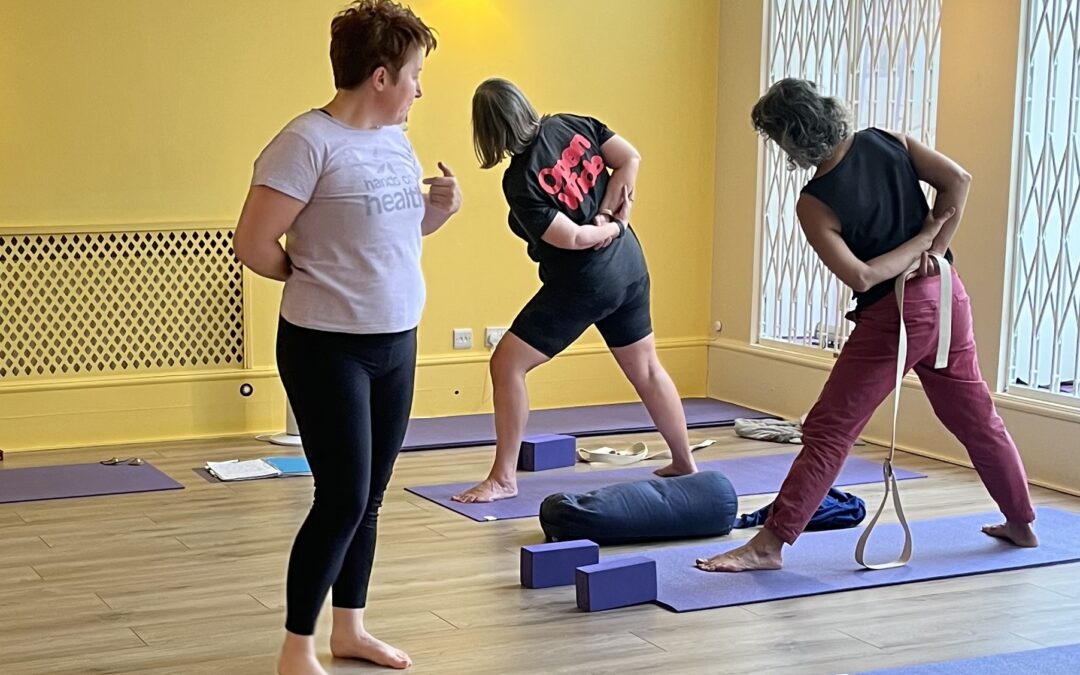
Iyengar takes that careful approach further. Named after B.K.S. Iyengar, this style is almost obsessively precise. Props – blocks, straps, blankets, bolsters – are used extensively to bring poses to you, rather than forcing your body into shapes it isn’t ready for. For anyone managing an injury, recovering from surgery, or dealing with chronic pain, Iyengar is often a revelation. The teachers tend to be rigorously trained.
 Restorative yoga is less exercise, more permission slip. Poses are fully supported by props and held for five to ten minutes. The nervous system slows down, tension releases, and many people find it profoundly emotional. If you’re burned out, anxious, or going through a difficult season of life, this is worth trying.
 Yoga Nidra sits at the furthest point from a workout. Practised lying down, it’s a guided meditation that takes you to the edge of sleep. Research suggests it can reduce cortisol, improve sleep quality, and support recovery. Don’t knock it until you’ve tried it — plenty of people find it more challenging than anything on this list.
 The middle ground
Vinyasa links breath to movement in a flowing sequence, with each pose transitioning into the next. Classes vary enormously depending on the teacher, so one person’s “moderate” Vinyasa is another’s breathless challenge. It’s a good all-rounder — building strength and flexibility together, with enough variety to stay interesting.
 Functional yoga is a newer term you’ll increasingly see on timetables. It borrows from physiotherapy and movement science to focus on how the body actually works day-to-day: hip mobility for sitting and walking, shoulder stability for carrying, spinal resilience for the long haul. Less mystical than some styles, more pragmatic — and for people in their 40s and 50s, often remarkably effective.
Yin yoga targets the connective tissue rather than the muscles. Poses are held passively for three to five minutes, creating a slow, deep release. It pairs well with more active styles and is particularly useful for people who are very muscular or very tight.
 The more demanding end
Ashtanga is a set sequence of poses, always in the same order, practised at a steady pace. It is physically demanding, disciplined, and somewhat traditional in its culture. Many people love its rigour and the meditative quality of repeating the same practice. It suits those who like structure and aren’t afraid of hard work, but it’s worth finding a teacher who can adapt it sensibly if you have any mobility limitations.
 Power yoga is essentially a gym-friendly version of Ashtanga — stronger, faster, less ceremonial. It will give you a real workout. Yoga Sculpt adds weights and sometimes cardio intervals to a yoga-inspired flow. It sits at the crossover between yoga and fitness class, and if you enjoy both, it can be satisfying. Just know it’s quite different in tone from more traditional styles. Hot yoga and Bikram both take place in a heated room — Bikram strictly at 40°C with a fixed 26-pose sequence, hot yoga more loosely defined. The heat makes muscles more pliable and the sweating can feel cathartic, but it raises your heart rate significantly and isn’t suitable for everyone. If you have cardiovascular concerns, blood pressure issues, or are prone to overheating, check with your GP first.
A few practical tips for your 40s and beyond
Always tell the teacher about any injuries, surgeries, or health conditions before the class begins. A good teacher will offer alternatives; a great one will check in on you during the session.
Free taster classes are your friend. Many studios offer them, and there’s no better way to find out whether a style – and a teacher – suits you than simply trying it.
The teacher matters as much as the style. A skilled Vinyasa teacher can make a fast-paced class feel accessible; a poor Hatha teacher can make a gentle one feel tedious.
If a class doesn’t click, try another teacher before you write off the whole style.
Finally, your body in your 40s is not your body in your 20s — and that’s entirely fine.
The most useful thing yoga can teach you at this stage of life is the difference between discomfort that builds you up and pain that breaks you down. Learning to make that distinction is, arguably, the whole practice.
Recent Comments